
Your website often serves as the first interaction potential customers have with your business. In today’s highly competitive digital environment, visitors expect websites to be fast, responsive, and easy to use. If your site is slow or struggles during busy periods, users are likely to leave before learning about your products or services.
Website performance is no longer simply a technical concern—it has become a crucial business factor that directly affects customer experience, search engine rankings, lead generation, and online sales. Businesses that invest in performance optimization create stronger user experiences while improving their ability to compete online.
This article explores why website speed and scalability matter, how they influence business success, and the best practices for building a high-performing website that continues to deliver results as your business expands.
What Does Website Performance Optimization Mean?
Website performance optimization involves improving every technical aspect of a website to ensure pages load quickly, function smoothly, and remain reliable under varying levels of traffic.
Rather than focusing on one specific improvement, optimization includes multiple areas such as:
- Faster page loading
- Efficient website code
- Optimized media files
- Improved server performance
- Database optimization
- Smart caching strategies
- Better mobile responsiveness
The goal is to create a website that delivers an excellent browsing experience while maximizing efficiency across different devices and internet connections.
Why Fast Websites Make a Difference
People expect instant access to information. Even a slight delay in loading time can influence whether someone stays on your website or chooses a competitor instead.
A fast website offers several advantages:
- Creates a strong first impression
- Makes navigation feel effortless
- Encourages visitors to explore additional pages
- Improves customer satisfaction
- Increases trust in your business
When visitors enjoy a smooth browsing experience, they are far more likely to engage with your content, submit enquiries, or complete purchases.
How Slow Performance Affects Your Business
Poor website performance impacts far more than user convenience. It can directly reduce your company’s revenue and marketing effectiveness.
Lower Conversion Rates
Every second added to page loading increases the likelihood that visitors will abandon your website before taking action. Whether your objective is collecting enquiries, booking appointments, or selling products, faster websites consistently achieve better conversion rates. However, speed is only one part of the equation—avoiding common website design mistakes that hurt conversions and understanding the key features of a high-converting business website can help you create an experience that not only attracts visitors but also encourages them to take meaningful action.
Increased Bounce Rates
Users rarely wait for slow-loading pages. If visitors cannot quickly access the information they need, they often leave immediately, reducing engagement and limiting opportunities to generate leads. The effect of poor website navigation further compounds this problem, as confusing menus and difficult site structures make it harder for users to find relevant content, increasing the likelihood that they abandon the website altogether.
Reduced Customer Confidence
Your website reflects your business.
A slow or unreliable website may cause visitors to question the professionalism and credibility of your company, even if you provide outstanding products or services.
Lost Business Opportunities
For online retailers, delays throughout the shopping experience frequently lead to abandoned carts and missed sales opportunities.
The longer customers wait, the greater the chance they will purchase elsewhere.
The Relationship Between Website Speed and SEO
Search engines aim to provide users with the highest-quality browsing experience. As a result, website speed has become an important factor in determining search rankings.
A high-performing website helps improve:
- Organic search visibility
- User engagement
- Crawl efficiency
- Mobile search performance
- Overall page experience
Technical optimization supports your broader SEO strategy by helping search engines discover, understand, and rank your content more effectively. While technical performance plays a critical role, implementing website design strategies that enhance SEO ensures your site’s structure, navigation, user experience, and mobile responsiveness all contribute to stronger search visibility. Many of these improvements originate during the development process, making it worthwhile to understand the SEO advantages of professional website development when building or upgrading your business website.
Understanding Google’s Core Web Vitals
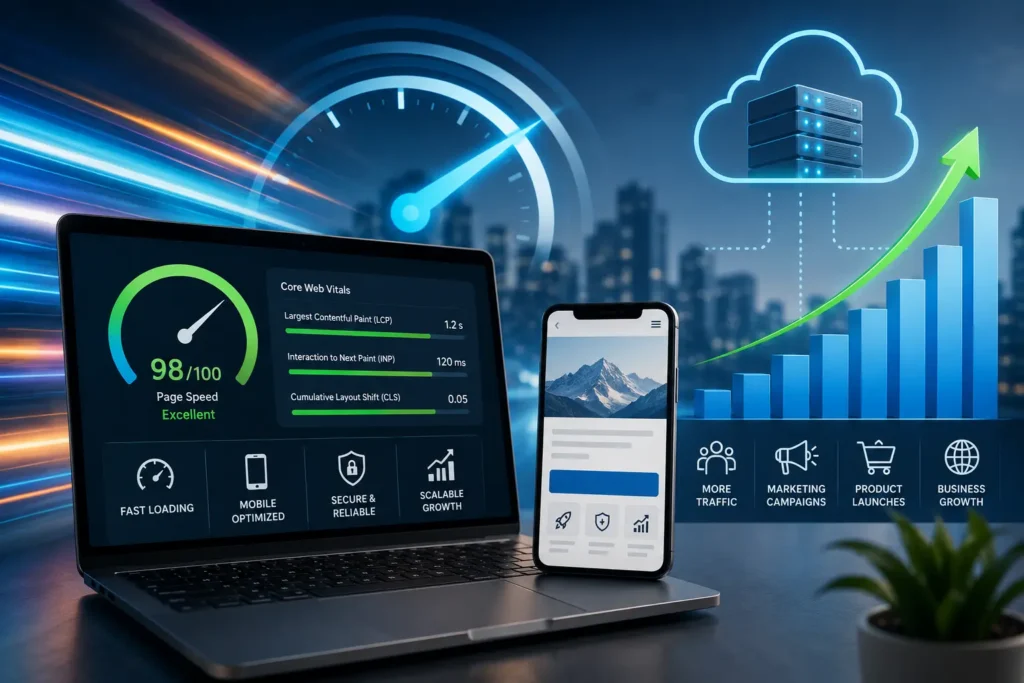
Google evaluates website performance using Core Web Vitals, a collection of metrics that measure real-world user experience.
These include:
Largest Contentful Paint (LCP)
This measures how quickly the largest visible element appears on a page.
A faster LCP means users can access important content sooner.
Interaction to Next Paint (INP)
INP evaluates how responsive your website feels when users click buttons, complete forms, or interact with menus.
Responsive websites create smoother browsing experiences.
Cumulative Layout Shift (CLS)
CLS measures visual stability while pages load.
Unexpected movement of images, buttons, or text can frustrate users and negatively impact usability.
Improving these metrics benefits both search rankings and visitor satisfaction.
Mobile Optimization Is More Important Than Ever
Most website traffic now comes from smartphones and tablets.
A website that performs well on desktop but poorly on mobile devices risks losing a significant percentage of potential customers.
Effective mobile optimization includes:
- Responsive page layouts
- Fast-loading images
- Efficient coding
- Optimized typography
- Easy-to-use navigation
- Touch-friendly design
Since Google primarily evaluates mobile versions of websites, mobile performance plays a major role in SEO success.
Why Scalability Matters
Website speed alone is not enough.
Your website must also be capable of handling increased demand as your business grows.
Scalable websites continue operating efficiently when experiencing:
- Higher visitor numbers
- Seasonal promotions
- Marketing campaigns
- Product launches
- Additional website content
- Business expansion
Without proper scalability, websites may become slow or unavailable during peak traffic, resulting in lost customers and revenue.
Common Reasons Websites Become Slow
Many performance problems develop over time due to poor maintenance or inefficient development practices.
Some of the most common causes include:
Oversized Images
Uploading large image files significantly increases loading times.
Compressing images and using modern formats helps improve performance without sacrificing visual quality.
Too Many Plugins
Adding excessive plugins often introduces unnecessary scripts and processing tasks.
Keeping only essential plugins reduces complexity and improves website speed.
Low-Quality Hosting
Your hosting provider directly affects website performance.
Inadequate server resources can create bottlenecks during periods of increased traffic.
Unoptimized Code
Large CSS and JavaScript files delay rendering and increase loading times.
Minifying code and removing unnecessary resources helps pages display faster.
Poor Cache Configuration
Without browser caching, repeat visitors must repeatedly download the same files.
Proper caching speeds up future visits and reduces server workload.
Database Inefficiencies
As websites grow, databases accumulate unnecessary information that slows queries.
Routine database optimization improves response times and overall performance.
Proven Techniques for Improving Website Performance
Businesses can significantly enhance website speed through several practical optimization methods.
Compress and Optimize Images
Using compressed WebP or AVIF images, responsive sizing, and lazy loading reduces page weight while maintaining image quality.
Use a Content Delivery Network
A CDN stores website assets across multiple geographic locations.
Visitors automatically receive content from the nearest server, reducing latency and improving loading speed.
Enable File Compression
Compression technologies such as Brotli and Gzip reduce file sizes before delivery, allowing browsers to load pages more quickly.
Minify Website Files
Removing unnecessary characters from HTML, CSS, and JavaScript decreases download sizes and improves rendering speed.
Configure Browser Caching
Caching allows returning visitors to access previously downloaded resources without making repeated server requests.
Reduce Unnecessary Requests
Simplifying page structure and limiting external resources minimizes the number of requests browsers must process.
Invest in Better Hosting
Growing businesses benefit from cloud hosting or scalable server environments capable of maintaining performance under heavy traffic.
Website Security Supports Better Performance
Security and performance are closely connected.
Maintaining an updated and secure website helps ensure consistent reliability and protects users from malicious attacks.
Important security measures include:
- SSL certificates
- Regular software updates
- Malware protection
- Firewalls
- Secure hosting environments
A secure website not only protects business data but also contributes to better performance and user confidence.
Performance Monitoring Should Never Stop
Website optimization is an ongoing process rather than a one-time project.
Regular performance reviews help identify issues before they begin affecting visitors.
Key performance indicators include:
- Loading speed
- Server response time
- Website uptime
- Core Web Vitals
- Bounce rate
- Conversion rate
- Mobile usability
Continuous monitoring ensures your website remains efficient as new features, content, and traffic are added.
Why Professional Website Development Delivers Better Results
Building a high-performing website requires more than attractive design. Professional developers create websites with speed, scalability, SEO, and security built into the foundation. This is why investing in professional website development services is crucial, as it ensures your website is engineered to deliver exceptional performance today while remaining flexible enough to support future business growth.
An experienced development team focuses on:
- Clean, maintainable code
- Performance-focused architecture
- Mobile-first development
- Search engine optimization
- Scalable infrastructure
- Strong security practices
This approach reduces long-term maintenance while delivering a consistently reliable experience for users.
Looking Ahead: The Future of Website Performance
Web technologies continue to evolve rapidly, and businesses should stay prepared for future advancements.
Emerging trends include:
- Artificial intelligence for performance optimization
- Edge computing
- Server-side rendering
- Static website generation
- Progressive Web Apps (PWAs)
- Advanced image delivery
- HTTP/3 implementation
Businesses that embrace these technologies will be better positioned to meet growing customer expectations and maintain a competitive online presence.
Conclusion
Website performance has become one of the most important factors influencing digital success. Fast-loading, scalable websites improve customer satisfaction, strengthen SEO, increase conversions, and provide a solid foundation for future business growth.
By investing in performance optimization from the beginning—and maintaining it over time—you can create a website that consistently delivers excellent user experiences while supporting your long-term business objectives.
Ready to Improve Your Website’s Performance?
If your website is slow, difficult to manage, or unable to keep pace with your business growth, professional support can make a significant difference. Horizon Services, a full-service digital agency based in Watford, UK, develops high-performance, scalable, and SEO-friendly websites designed to help businesses succeed online.
Whether you need a completely new website or want to enhance your existing one, our experienced team is ready to help.
Hire website designers and developers in Watford and discover how Horizon Services can build a faster, more reliable website that supports your business today and continues to grow with it.


