
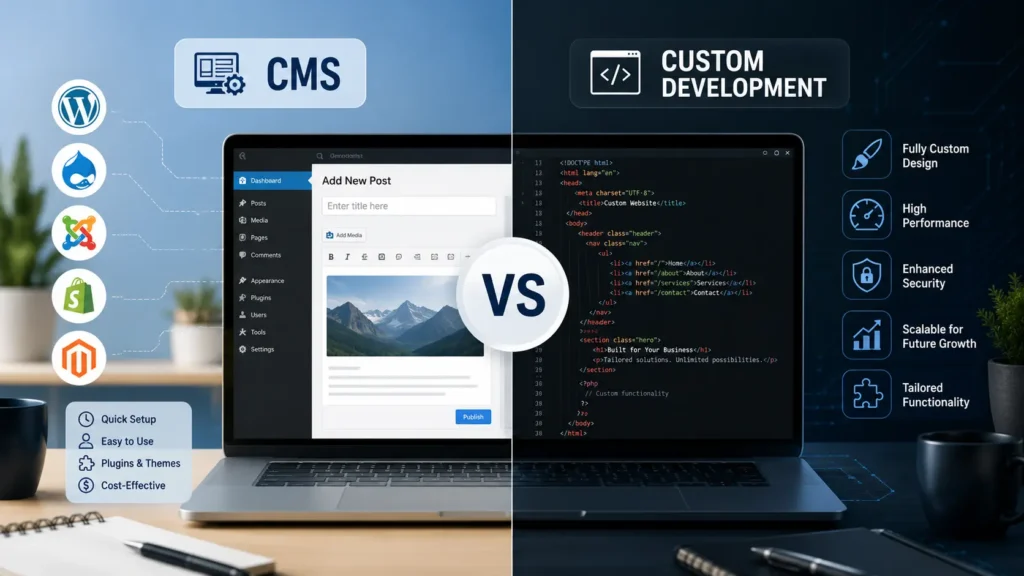
Building a website is one of the most important investments a business can make in today’s digital landscape. Whether you’re launching a new company, refreshing an outdated website, or expanding your online services, one of the first decisions you’ll need to make is choosing between a content management system (CMS) and a fully custom-built website.
Each approach offers distinct advantages, and selecting the right one depends on factors such as your budget, business objectives, technical requirements, and future growth plans. While a CMS offers convenience and quicker deployment, custom development provides unmatched flexibility and the ability to create highly tailored digital experiences.
This guide explains the differences between these two development methods, helping you understand which option aligns best with your business needs.
Understanding a Content Management System (CMS)
A Content Management System is a platform that enables businesses to create and manage website content without requiring extensive coding knowledge. It provides an easy-to-use interface where users can edit pages, publish blog posts, upload images, and maintain their websites with minimal technical expertise.
Popular CMS platforms include WordPress, Drupal, Joomla, Shopify, and Magento. These systems come equipped with ready-made templates, plugins, and built-in tools that simplify website management and reduce development time.
Because much of the core functionality already exists, CMS websites are generally faster and more affordable to build than custom-developed solutions.
What Does Custom Website Development Mean?
Custom website development involves designing and building a website specifically for a business rather than relying on pre-built themes or templates. Every feature, page, and functionality is developed according to unique project requirements.
Developers typically use modern technologies and frameworks to create these bespoke websites, ensuring complete control over design, functionality, performance, and scalability. This approach is ideal for businesses with specialised processes or advanced digital requirements that cannot be effectively addressed through standard CMS platforms.
Comparing CMS and Custom Development
Development Timeline
A CMS allows websites to be developed relatively quickly because many essential features are already available through themes and extensions. Businesses looking for a faster launch often find this approach highly practical.
Custom websites, however, require significantly more planning and development. Every component—from the user interface to backend functionality—is created from scratch, resulting in longer project timelines but far greater flexibility.
Budget Considerations
Cost is often a deciding factor for businesses choosing between these two options.
CMS websites generally involve lower initial development costs because developers can build upon existing systems rather than creating every feature manually. This makes them particularly attractive to startups and small businesses.
Custom development requires a larger upfront investment due to the amount of design, programming, testing, and quality assurance involved. Although the initial expense is higher, businesses often benefit from a solution that is tailored specifically to their operations and capable of supporting future growth.
Design Freedom
Businesses seeking a distinctive online identity may find custom development more appealing.
CMS platforms provide thousands of professionally designed themes, but these often have structural limitations. Significant design changes may require additional plugins or custom coding.
A custom-built website removes these restrictions, allowing designers and developers to create every visual element according to the company’s branding, customer journey, and marketing goals.
Website Performance
Performance plays an essential role in user satisfaction, search engine rankings, and conversion rates.
CMS websites can become slower when numerous plugins and third-party scripts are installed, especially if they are not properly maintained or optimised.
Custom websites are typically leaner because they include only the features the business actually needs. This streamlined code often results in faster loading times and improved overall performance.
Security
Protecting customer information and business data should always be a priority.
Because CMS platforms are widely used across millions of websites, they are frequent targets for cyberattacks. Outdated plugins or themes can introduce vulnerabilities if regular maintenance is neglected.
Custom-developed websites generally present fewer common attack points because the underlying code is unique to the business. Combined with secure coding practices and ongoing maintenance, they can offer a higher level of protection.
Scalability
As businesses expand, their websites often need to accommodate additional functionality such as customer portals, advanced reporting systems, CRM integrations, booking platforms, or bespoke applications.
While many CMS platforms can support these requirements through plugins, relying heavily on third-party extensions may eventually create compatibility and performance challenges.
Custom development offers greater flexibility for long-term growth, making it easier to introduce new features without being constrained by platform limitations.
Managing Website Content
One of the greatest strengths of a CMS is its ease of use.
Marketing teams and business owners can update text, publish blogs, upload media, create new pages, and manage products without technical assistance. However, as websites grow and additional plugins, themes, and integrations are introduced, occasional technical challenges may arise. Understanding common CMS problems and how to fix them can help businesses minimise downtime, improve website performance, and keep their content management system running efficiently.
Custom websites can also include user-friendly content management functionality, but these features must be specifically developed as part of the project, increasing both development time and cost.
Search Engine Optimisation
Both CMS and custom-built websites can perform exceptionally well in search engines when developed according to SEO best practices. CMS platforms often include plugins that simplify tasks such as managing metadata, creating XML sitemaps, implementing schema markup, and handling redirects. Custom websites allow developers to optimise every technical aspect of SEO directly within the codebase, including page speed, Core Web Vitals, structured data, and clean URL architecture. For businesses looking to strengthen both technical SEO and user experience, following an SEO-friendly web design guide can provide valuable insights into building websites that are both search-engine friendly and user-focused. Regardless of the platform you choose, understanding the key features of a high converting business website can help ensure your site not only ranks well but also turns visitors into customers. Ultimately, successful SEO depends more on implementation quality than on the platform itself.
Ongoing Maintenance
Every website requires regular maintenance to remain secure, reliable, and compatible with evolving technologies.
CMS websites need frequent updates to their core software, plugins, and themes. Businesses that ignore these updates increase the risk of security issues and technical problems.
Custom-built websites also require periodic updates, although these are generally focused on server environments, frameworks, performance improvements, and security enhancements rather than numerous third-party components.
Which Businesses Benefit Most from a CMS?
A CMS is often the ideal solution for organisations that want a professional website without a substantial development budget. Small businesses, local service providers, consultants, bloggers, charities, and many eCommerce startups can all benefit from the affordability and simplicity offered by CMS platforms.
Their intuitive dashboards also make it easy for non-technical staff to manage website content independently.
When Is Custom Development the Better Choice?
Businesses with specialised requirements often achieve greater long-term value through custom development.
Companies that require advanced integrations, bespoke workflows, customer portals, online booking systems, membership platforms, SaaS products, or enterprise-level applications usually benefit from a website designed specifically around their operational needs.
Custom development also provides the flexibility to expand functionality as business demands evolve.
Cost Comparison
The financial investment required depends largely on the scope and complexity of the project. In general, CMS websites involve lower upfront costs because they utilise existing templates and built-in functionality, allowing projects to be completed more quickly. Custom website development requires a larger initial investment due to the extensive planning, design, coding, testing, and quality assurance involved. However, businesses choosing custom development often benefit from superior performance, greater flexibility, enhanced security, and improved scalability, making it a worthwhile long-term investment for organisations with ambitious growth plans. While a CMS may be the more economical choice initially, the overall value should be measured by how well the website supports your business over time rather than simply its starting price.
Final Thoughts
There is no one-size-fits-all answer when deciding between a CMS and custom website development. The most suitable option depends on your business objectives, available budget, technical requirements, and long-term strategy. Taking the time to evaluate factors such as scalability, performance, maintenance, and choosing the right technology for your business website will help you make a more informed decision that aligns with your long-term goals. If you’re still weighing your options, our guide on Which is better: custom website or website builder? offers additional insights to help you compare these approaches and choose the solution that best fits your business. If your priority is launching a professional website quickly while keeping development costs under control, a CMS offers an excellent balance of affordability and functionality. On the other hand, businesses seeking complete flexibility, advanced capabilities, higher performance, and room for future expansion are likely to benefit more from a custom-developed solution. Carefully assessing both your current requirements and future ambitions will help ensure your website continues to support your business for years to come.
Partner with Horizon Services for Expert Website Development
Whether you need a user-friendly CMS website or a fully customised web application, choosing the right development partner is just as important as choosing the right platform. Horizon Services, a full-service digital agency based in Watford, UK, delivers tailored website design and development solutions that combine attractive design, strong performance, and long-term scalability. If you’re searching for a reliable website development company in Watford, our experienced team is ready to help you create a website that supports your business goals and drives measurable results. Contact Horizon Services today to discuss your next web development project.


