
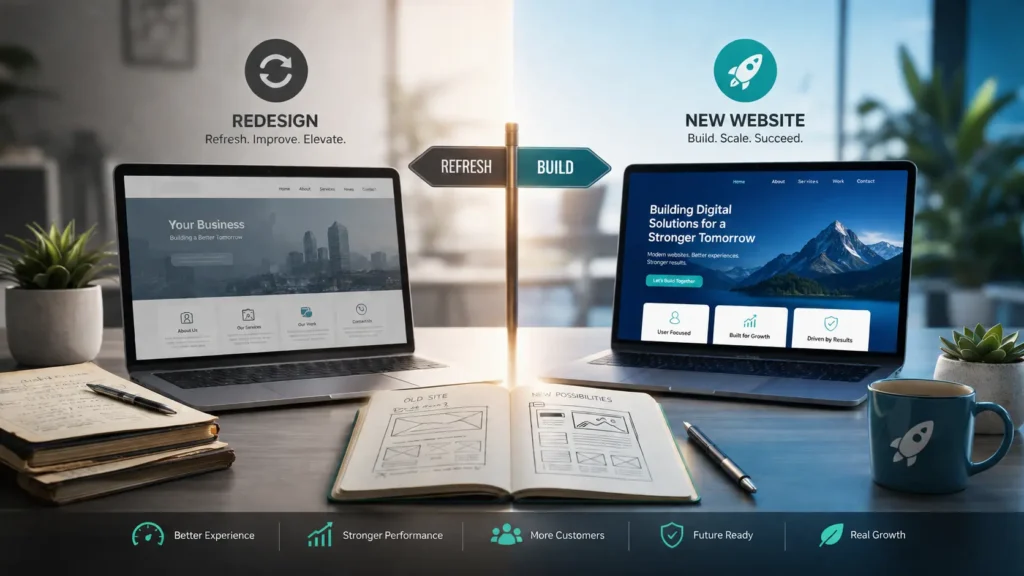
Your website plays a critical role in shaping how potential customers perceive your business. In today’s competitive digital landscape, people often decide within seconds whether to stay on your site or leave. If your website feels outdated, loads slowly, or fails to provide a smooth user experience, it could be costing you valuable leads and sales.
As businesses grow and customer expectations evolve, many owners face an important decision: Should you refresh your current website, or is it time to start over with an entirely new one?
While both options can improve your online presence, they serve different purposes. A website redesign focuses on enhancing an existing site, whereas a new website project creates an entirely fresh digital platform. Choosing the right path depends on factors such as your current website’s condition, business objectives, future growth plans, and available budget.
This guide explains the key differences between redesigning a website and building a new one, helping you determine which approach offers the greatest long-term value.
Understanding a Website Redesign
A website redesign involves improving your existing website without completely replacing it. The goal is to modernize its appearance, enhance usability, and improve overall performance while retaining much of the current framework.
Rather than rebuilding everything from the ground up, designers and developers update selected areas that need improvement. This often includes visual enhancements, navigation improvements, performance optimization, and better mobile compatibility.
A typical redesign may involve:
- Refreshing the visual design to match current trends
- Improving navigation for easier browsing
- Updating colours, typography, and graphics
- Enhancing mobile responsiveness
- Increasing website loading speed
- Optimising pages for search engines
- Improving accessibility and usability
- Adding or upgrading existing features
For businesses with a technically stable website, a redesign can provide significant improvements without requiring a complete rebuild.
What Does Building a Brand-New Website Involve?
Creating a new website means developing an entirely new online platform from scratch. Instead of working around the limitations of an existing website, every aspect is planned according to your current business goals and future requirements.
This process usually begins with research and strategy before moving into design, development, testing, and launch.
A new website project generally includes:
- Planning a completely new site structure
- Creating custom page layouts
- Designing a modern user interface
- Developing new functionality
- Selecting updated technologies
- Implementing stronger security measures
- Building a scalable website architecture
- Creating an SEO-friendly foundation
Although this option requires more time and investment, it provides greater flexibility and supports long-term business growth.
When a Website Redesign Is the Better Choice
Not every ageing website needs to be replaced entirely. In many cases, updating what’s already working can deliver excellent results.
Your Design No Longer Reflects Your Brand
Design styles evolve rapidly. If your website appears dated compared to your competitors, visitors may assume your business is also behind the times.
Refreshing your site’s visual identity can improve credibility while maintaining your existing content and functionality.
Your Content Still Provides Value
If your service pages, blog articles, and other content remain accurate and useful, rebuilding every page may not be necessary.
A redesign allows you to present valuable information in a more engaging and user-friendly format.
Your Website Performs Reliably
If there are no significant technical issues, broken functionality, or security concerns, improving the user experience may be enough to achieve your goals.
Your Search Rankings Are Strong
Businesses with well-established SEO performance often benefit from redesigning instead of rebuilding. By preserving important URLs and page authority, you reduce the risk of losing valuable organic traffic.
Budget Is an Important Consideration
Since redesign projects typically involve less development work, they are often more affordable than building an entirely new website.
Signs You Should Build a New Website
Sometimes improving an old website only delays larger problems. If the foundation itself is outdated, starting fresh often provides better long-term value.
Your Website Runs on Obsolete Technology
Older content management systems and outdated frameworks can create security risks, slow performance, and compatibility issues with modern browsers.
Replacing the website allows you to benefit from current technologies and ongoing platform support.
Mobile Users Have a Poor Experience
With most internet traffic now coming from smartphones and tablets, responsive design is essential.
If your current website struggles to perform well on mobile devices, rebuilding it with a mobile-first approach can significantly improve user satisfaction.
Performance Is Consistently Slow
Visitors expect pages to load almost instantly. A sluggish website often increases bounce rates and reduces conversions.
When slow performance results from outdated coding or poor architecture, rebuilding the website is often more effective than attempting repeated fixes.
Your Website Structure Has Become Confusing
As businesses expand, websites often accumulate new pages without a clear organisational strategy.
A new website enables you to create a logical structure that helps visitors quickly find the information they’re looking for.
Your Business Has Evolved
Businesses frequently introduce new services, expand into additional markets, or undergo rebranding.
If your existing website no longer represents your business accurately, developing a new website allows your digital presence to reflect your current identity.
Security Needs Have Increased
Cybersecurity is more important than ever. Older websites may contain vulnerabilities that expose customer information or business data.
Modern development practices include stronger security measures that help safeguard both your organisation and your visitors.
Comparing the Two Approaches
Cost
A redesign generally costs less because it builds upon your existing website.
A new website requires greater investment due to additional planning, design, development, testing, and migration. However, it may reduce future maintenance expenses and provide better long-term value.
Project Timeline
Updating an existing website usually takes less time than creating one from scratch.
A completely new website requires extensive planning and development, resulting in a longer production schedule.
Customisation
A redesign may be limited by your current platform’s capabilities.
Building a new website gives developers complete freedom to implement modern functionality, advanced integrations, and scalable architecture.
Search Engine Optimisation
Both options can improve SEO when executed correctly.
A redesign should carefully preserve existing rankings, while a new website requires proper redirects, content migration, and technical SEO planning to maintain search visibility.
Long-Term Growth
Businesses expecting rapid expansion often benefit from a newly built website because it can be designed with future scalability in mind.
Questions to Consider Before Deciding
Before selecting either option, ask yourself:
- Does my website accurately represent my business today?
- Is it helping generate enquiries or sales?
- Is the user journey simple and intuitive?
- Does the website perform well on mobile devices?
- Are technical issues becoming increasingly common?
- Can my current platform support future business goals?
- Will I need additional functionality in the near future?
- Is my website meeting modern SEO standards?
Your answers will help determine whether updating or rebuilding is the smarter investment.
Why User Experience Matters More Than Ever
Whether you’re redesigning or replacing your website, user experience should remain at the centre of every decision.
Modern visitors expect websites that are:
- Fast and responsive
- Easy to navigate
- Optimised for every device
- Secure and reliable
- Visually engaging
- Accessible to all users
- Simple to understand
An attractive website alone is no longer enough. Visitors should be able to move naturally through your website and complete important actions without frustration.
Don’t Overlook SEO During the Process
A website project should improve not only how your site looks but also how easily potential customers can discover it. Whether you’re redesigning an existing site or launching a brand-new one, following a comprehensive website design checklist before launch helps ensure that critical elements such as SEO, performance, security, and usability have all been properly reviewed before your website goes live. A website project should improve not only how your site looks but also how easily potential customers can discover it.
Key SEO elements include:
- Well-organised site architecture
- Search-friendly URL structures
- Fast loading pages
- Mobile optimisation
- Optimised images
- Strategic internal linking
- Structured data implementation
- High-quality metadata
- Proper redirects
- Valuable, informative content
Integrating SEO from the beginning helps preserve existing rankings while creating new opportunities for organic growth.
Which Option Offers Greater Value?
The answer depends entirely on your current website.
If your website already has a reliable technical foundation but needs a visual update and improved usability, a redesign often delivers an excellent return on investment.
However, if your website suffers from outdated technology, ongoing maintenance issues, security concerns, or limited scalability, investing in a completely new website usually provides greater long-term benefits.
Rather than focusing only on the initial cost, consider how your website will support your business over the next several years.
Final Thoughts
There is no one-size-fits-all solution when deciding between redesigning a website and building a new one. The right choice depends on your business goals, technical requirements, marketing strategy, and plans for future growth.
A redesign can breathe new life into an existing website that already has a solid foundation, while a new website offers the opportunity to eliminate outdated limitations and create a future-ready digital platform.
By evaluating your website objectively and working with experienced professionals, you can make an investment that strengthens your online presence, improves customer experience, and supports sustainable business growth.
Ready to Transform Your Website?
Whether your existing website needs a modern refresh or you’re ready to launch an entirely new digital platform, partnering with experienced professionals can help you achieve the best results. At Horizon Services, we create visually impressive, user-focused websites that are designed to perform, convert visitors into customers, and grow alongside your business.
If you’re searching for professional website design and development services in Watford, our team is ready to help you identify the right solution and build a website that supports your business objectives today and into the future. Contact Horizon Services to discuss your next website project.


