
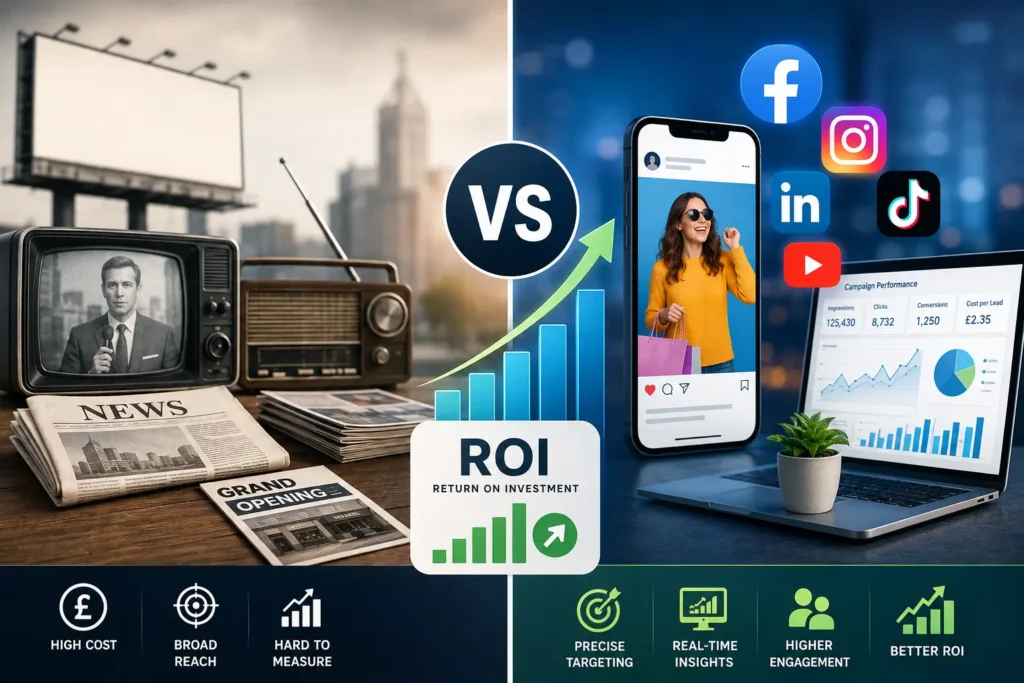
In today’s competitive business environment, companies face countless choices when deciding where to invest their marketing budgets. From television commercials and newspaper advertisements to Instagram campaigns and LinkedIn promotions, each channel offers unique advantages. However, one question consistently arises among business owners and marketers: Which approach provides better ROI—social media marketing or traditional marketing?
Return on Investment (ROI) is one of the most important factors in evaluating marketing success. Businesses want assurance that every pound spent contributes to measurable outcomes, whether that’s increased brand visibility, higher website traffic, more qualified leads, or improved sales performance.
As consumer behavior continues to shift toward digital platforms, understanding the effectiveness of both traditional and social media marketing is essential. This guide explores how each strategy works, compares their ability to generate ROI, and helps businesses determine the most effective approach for their goals.
What Is Traditional Marketing?
Traditional marketing encompasses conventional advertising methods that businesses have relied on for many years to promote their products and services. These offline channels include:
- Television advertising
- Radio promotions
- Newspaper advertisements
- Magazine placements
- Outdoor advertising such as billboards
- Direct mail campaigns
- Printed brochures and flyers
- Sponsorships and event marketing
Although digital marketing has gained significant momentum, traditional marketing continues to play an important role in helping businesses establish brand awareness and reach large audiences.
Benefits of Traditional Marketing
Extensive Audience Exposure
Traditional media platforms, especially television and radio, have the ability to reach a vast number of people within a short period. For brands aiming to build widespread recognition, this broad exposure can be highly beneficial.
Enhanced Brand Credibility
Many consumers still associate established media outlets with reliability and trust. Seeing a business featured in a respected newspaper or on television often reinforces its legitimacy.
Strong Local Market Presence
Local newspapers, community radio stations, and outdoor advertisements can effectively target audiences within specific geographic regions, making them valuable for regional businesses.
Physical Marketing Materials
Printed materials such as brochures, postcards, and flyers offer tangible experiences that some consumers find more memorable than digital interactions.
Challenges Associated with Traditional Marketing
While traditional marketing offers several advantages, it also presents notable limitations:
- Significant advertising costs
- Limited audience targeting options
- Difficulty in accurately measuring campaign effectiveness
- Reduced flexibility once campaigns are launched
- Minimal opportunities for direct customer interaction
These challenges can affect the overall return businesses receive from their marketing investments.
Understanding Social Media Marketing
Social media marketing involves leveraging platforms such as Facebook, Instagram, LinkedIn, TikTok, YouTube, and X to connect with target audiences and promote products or services.
Businesses use social media to accomplish objectives such as:
- Increasing brand awareness
- Driving website traffic
- Generating leads
- Improving customer engagement
- Building online communities
- Strengthening customer relationships
- Boosting sales and conversions
As social platforms continue to dominate consumer attention, they have become an essential component of modern marketing strategies.
Advantages of Social Media Marketing
Advanced Audience Targeting
One of the most powerful aspects of social media advertising is its ability to target highly specific audience segments. Businesses can refine campaigns based on factors such as:
- Age and gender
- Geographic location
- Interests and hobbies
- Purchasing behaviors
- Professional roles
- Online activity patterns
- Custom audience data
This precision helps ensure that marketing budgets are spent reaching individuals most likely to become customers.
Budget-Friendly Advertising Opportunities
Compared to traditional advertising channels, social media campaigns often require lower financial investment. Businesses of all sizes can launch campaigns that align with their budgets while maintaining the ability to scale as needed.
Comprehensive Performance Insights
Social media platforms provide detailed analytics that allow marketers to monitor campaign effectiveness in real time. Key performance indicators include:
- Reach and impressions
- Click-through rates
- Engagement levels
- Conversion rates
- Cost per click
- Cost per lead
- Return on ad spend
These insights support ongoing optimization and more informed decision-making.
Improved Customer Interaction
Unlike traditional advertising, social media encourages two-way communication between businesses and their audiences. Customers can engage with brands by:
- Commenting on posts
- Sharing content
- Asking questions
- Leaving reviews
- Providing feedback
This interaction helps businesses foster stronger relationships and build trust with their audience.
Greater Flexibility
Social media campaigns can be adjusted quickly based on performance data. Marketers can modify budgets, targeting parameters, ad creatives, and messaging without significant delays or additional costs.
Comparing ROI: Social Media Marketing vs Traditional Marketing
To determine which marketing approach delivers stronger returns, it’s important to evaluate several critical factors.
Cost Effectiveness
Traditional Marketing
Traditional advertising often involves considerable upfront investment. Television commercials require production budgets and media buying costs, while print and billboard campaigns frequently demand ongoing expenditure.
Examples include:
- High costs associated with television placements
- Expensive outdoor advertising contracts
- Recurring expenses for newspaper and magazine advertisements
For smaller businesses, these costs can quickly become prohibitive.
Social Media Marketing
Social media platforms offer flexible budgeting options that enable businesses to start small and expand successful campaigns over time. This accessibility makes digital advertising more attainable for organizations with limited resources.
ROI Advantage: Social Media Marketing
Lower costs combined with scalable investment opportunities generally result in more efficient use of marketing budgets.
Audience Targeting Precision
Traditional Marketing
Traditional channels typically focus on reaching broad audiences. While this can increase exposure, it often means businesses pay to advertise to individuals outside their ideal customer profile.
For example, a local business advertising nationally may reach many consumers who are unlikely to purchase its products or services.
Social Media Marketing
Digital platforms enable advertisers to deliver messages directly to carefully selected audience segments based on detailed demographic and behavioral data.
ROI Advantage: Social Media Marketing
Improved targeting reduces wasted expenditure and enhances the likelihood of conversions.
Measurement and Reporting
Traditional Marketing
Evaluating the direct impact of traditional campaigns can be challenging. Although businesses may access estimates such as circulation numbers or viewership statistics, accurately attributing sales to specific campaigns is often difficult.
Social Media Marketing
Social platforms provide comprehensive reporting tools that track campaign performance throughout the customer journey.
Businesses can identify:
- Which advertisements generate leads
- Which audiences respond most positively
- Which content drives conversions
- How much it costs to acquire each customer
ROI Advantage: Social Media Marketing
Data-driven insights enable continuous improvements that maximize marketing effectiveness.
Speed and Adaptability
Traditional Marketing
Launching traditional campaigns often requires lengthy planning processes, content production, media negotiations, and distribution timelines. Making changes after publication or broadcast can be both expensive and impractical.
Social Media Marketing
Digital campaigns can be implemented quickly and adjusted in real time based on performance metrics.
ROI Advantage: Social Media Marketing
The ability to respond rapidly to trends and optimize campaigns improves overall efficiency.
Brand Awareness Potential
Traditional Marketing
Mass media channels continue to excel at delivering widespread exposure. Television commercials and outdoor advertising remain valuable tools for organizations seeking broad market recognition.
Social Media Marketing
Social platforms can also increase brand visibility, although they often require consistent content creation and audience engagement over time.
ROI Advantage: Depends on Objectives
For large-scale awareness initiatives, traditional marketing may still be highly effective. For targeted audience growth, social media frequently provides stronger returns.
Customer Engagement Opportunities
Traditional Marketing
Traditional advertising primarily delivers one-way communication. Consumers receive information but have limited opportunities to interact with brands directly.
Social Media Marketing
Social platforms facilitate ongoing conversations that help businesses build stronger customer relationships and communities.
This engagement often contributes to increased customer loyalty and repeat business.
ROI Advantage: Social Media Marketing
Enhanced interaction supports long-term customer value and advocacy.
Situations Where Traditional Marketing Remains Effective
Although digital marketing dominates many industries, traditional methods continue to provide value in certain circumstances.
Traditional marketing may still be beneficial when businesses aim to:
- Reach older demographics who engage less with social platforms
- Conduct large-scale awareness campaigns
- Strengthen local community presence
- Enhance credibility through established media channels
- Support integrated multi-channel marketing efforts
Industries such as healthcare, financial services, and real estate often benefit from combining traditional and digital strategies.
Why Combining Both Approaches Can Be Effective
The discussion surrounding social media marketing versus traditional marketing is not always about choosing one exclusively.
Many successful organizations integrate both approaches to create cohesive marketing experiences.
Examples include:
- Television advertisements directing audiences to social media channels
- Printed materials featuring QR codes linked to online campaigns
- Event sponsorships supported by digital promotion
- Outdoor advertising combined with online retargeting strategies
This integrated approach allows businesses to engage customers through multiple touchpoints throughout the buying journey.
Which Marketing Strategy Offers Better ROI?
For most businesses, particularly small and medium-sized enterprises, social media marketing generally provides stronger ROI due to several advantages:
- Lower advertising costs
- Precise audience targeting
- Detailed performance tracking
- Real-time optimization capabilities
- Higher levels of customer engagement
- Clear conversion measurement
However, the most suitable marketing strategy depends on factors such as:
- Business objectives
- Industry characteristics
- Customer demographics
- Available marketing budget
- Geographic reach requirements
Organizations targeting digitally engaged audiences are likely to achieve greater returns through social media initiatives, while businesses seeking broader market exposure may benefit from a balanced marketing mix.
Conclusion
The way businesses market their products and services continues to evolve alongside changing consumer behaviors. Although traditional marketing still holds value in specific situations, social media marketing has emerged as a highly efficient and measurable solution for companies focused on maximizing ROI.
The key to marketing success lies in understanding your audience, establishing clear goals, and continuously refining strategies based on performance data. By adopting a strategic approach to budget allocation and campaign optimization, businesses can generate meaningful results and sustainable growth.
For many organizations, social media marketing offers the flexibility, affordability, and accountability needed to thrive in today’s digital landscape.
Looking to Improve Your Social Media Results?
If you want to strengthen your online presence, attract qualified leads, and increase revenue, understanding the strategies behind generating leads through social media marketing can help your business build a more effective digital presence. Partnering with experienced professionals can accelerate your success through tailored campaigns that deliver measurable business outcomes. Understanding the advantages of professional social media marketing services can help businesses make informed decisions about investing in strategies that deliver measurable growth and long-term ROI.
Horizon Services, a Watford-based full-service digital agency, specializes in creating tailored social media marketing strategies designed to deliver measurable business outcomes and long-term success.
Discover how our top social media marketing agency in Watford, UK can help your business maximize ROI with customized social media solutions that align with your unique objectives.


