
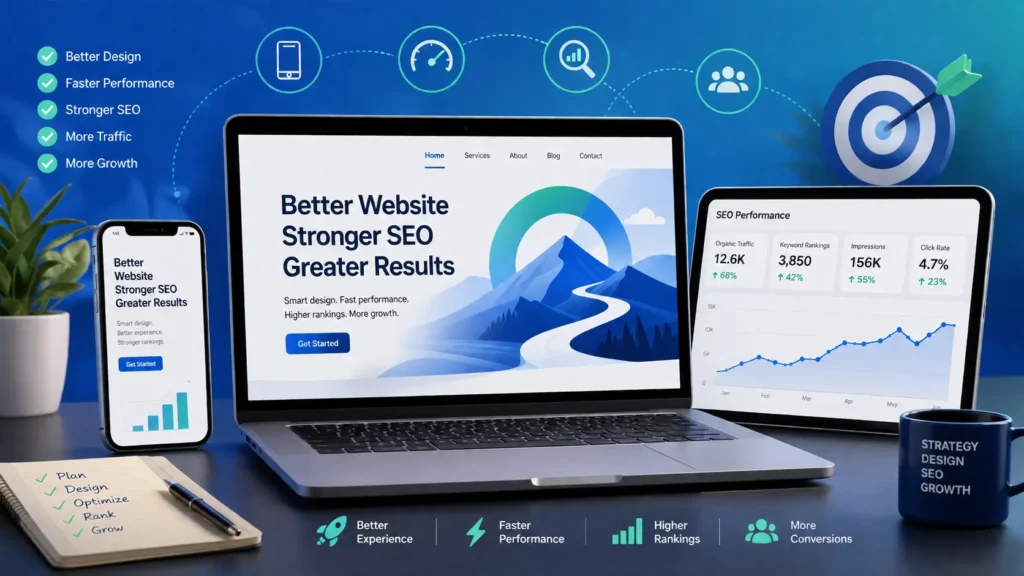
In today’s competitive digital landscape, having a visually appealing website is no longer enough. Your website also needs to perform well in search engines if you want to attract consistent organic traffic. While many businesses focus on keywords and backlinks when discussing SEO, website design plays an equally important role. A well-designed website helps search engines understand your content while providing visitors with an excellent browsing experience.
Modern search engine algorithms prioritize websites that offer speed, usability, accessibility, and valuable content. If your website is difficult to navigate, slow to load, or not optimized for mobile devices, your rankings may suffer regardless of how good your content is.
In this guide, we’ll explore the most effective website design strategies that improve SEO and help your business achieve better visibility online.
Why Website Design Matters for SEO
Website design and SEO are closely connected. Search engines aim to deliver the best possible results to users, meaning they favor websites that provide excellent user experiences. Good design encourages visitors to stay longer, browse multiple pages, and engage with your content—all positive behavioral signals that can indirectly support better search rankings.
An SEO-friendly website combines attractive visuals with technical optimization. Along with design best practices, choosing right technology for your business website plays a crucial role in determining your site’s speed, scalability, security, and overall SEO performance. Every design element, from navigation menus to page speed, contributes to how search engines evaluate your website.
Prioritize Mobile-First Design
Mobile devices account for the majority of internet traffic worldwide. Since Google primarily uses mobile-first indexing, it evaluates your website based on its mobile version.
A responsive website automatically adjusts to different screen sizes, ensuring users have a seamless experience whether they’re browsing on smartphones, tablets, or desktops.
Best practices include:
- Responsive layouts
- Readable font sizes
- Touch-friendly buttons
- Optimized images
- Fast mobile loading speeds
Mobile-friendly websites reduce bounce rates and improve user engagement, both of which contribute positively to SEO performance.
Improve Website Loading Speed
Page speed is one of Google’s confirmed ranking factors. Users expect websites to load quickly, and even a delay of a few seconds can lead to higher abandonment rates. Understanding why optimizing website speed is essential can help businesses prioritize performance improvements that enhance both user experience and search engine rankings.
Several design improvements can significantly enhance loading performance:
- Compress images without sacrificing quality
- Use modern image formats like WebP
- Minimize CSS and JavaScript files
- Enable browser caching
- Use Content Delivery Networks (CDNs)
- Reduce unnecessary animations
Fast-loading websites create better user experiences while helping search engines crawl pages more efficiently.
Create a Clear Site Structure
A logical website architecture benefits both users and search engine crawlers.
Organize your website into clear categories and maintain a hierarchy that allows visitors to find information within a few clicks.
An effective structure looks like this:
- Homepage
- Services
- About
- Blog
- Contact
Each important page should be accessible through internal navigation, reducing orphan pages and improving crawlability.
Design User-Friendly Navigation
Navigation directly affects user experience and SEO.
Visitors should immediately understand where they are and how to reach the information they need.
Tips for effective navigation include:
- Keep menus simple
- Limit unnecessary dropdown levels
- Include descriptive labels
- Add breadcrumb navigation
- Use consistent navigation across all pages
Simple navigation encourages users to explore more pages, increasing session duration.
Use SEO-Friendly URLs
Website URLs should be clean, readable, and descriptive.
Instead of:
example.com/page?id=254
Use:
example.com/website-design-strategies
SEO-friendly URLs improve readability, encourage clicks, and help search engines understand page content.
Optimize Header Structure
A proper heading hierarchy makes content easier to understand for both readers and search engines.
Each page should include:
- One H1 heading
- Multiple H2 sections
- Supporting H3 and H4 headings where appropriate
Well-structured content improves readability and helps search engines identify important topics.
Focus on High-Quality User Experience (UX)
Google increasingly rewards websites that provide positive user experiences.
Good UX includes:
- Clean layouts
- Consistent branding
- Easy readability
- Clear call-to-action buttons
- Minimal distractions
When users enjoy navigating your website, they’re more likely to stay longer and convert into customers.
Optimize Images Properly
Images enhance visual appeal but can negatively affect SEO if not optimized.
Best practices include:
- Compress image sizes
- Add descriptive file names
- Write meaningful alt text
- Use responsive image sizes
- Avoid uploading oversized graphics
Alt text also improves accessibility while providing additional context for search engines.
Improve Internal Linking
Internal links help search engines discover pages while guiding users toward relevant content.
For example, a blog about SEO can naturally link to:
- Website design services
- Local SEO
- Content marketing
- Technical SEO
Effective internal linking distributes authority across your website and keeps visitors engaged.
Design for Readability
Readable content improves engagement and encourages visitors to spend more time on your website.
Consider:
- Short paragraphs
- Plenty of white space
- Bullet points
- Large readable fonts
- Good color contrast
Well-formatted content reduces fatigue and improves user satisfaction.
Secure Your Website with HTTPS
Security is another ranking factor.
An SSL certificate encrypts data between users and your website while displaying the secure padlock icon.
HTTPS builds trust and reassures visitors that their information is protected.
Optimize Core Web Vitals
Google measures user experience using Core Web Vitals, including:
Largest Contentful Paint (LCP)
Measures loading performance.
Interaction to Next Paint (INP)
Measures responsiveness to user interactions.
Cumulative Layout Shift (CLS)
Measures visual stability during loading.
Website design should minimize layout shifts and prioritize stable, fast-loading pages.
Make Content Easy to Scan
Most visitors don’t read every word.
Instead, they scan pages looking for relevant information.
Improve scanability with:
- Headings
- Bullet lists
- Bold important points
- Short paragraphs
- Informative visuals
This encourages users to stay engaged while making content easier for search engines to understand.
Use Schema Markup
Schema markup helps search engines understand your website more effectively.
Common schema types include:
- Organization
- Local Business
- FAQ
- Reviews
- Articles
- Products
- Services
Proper implementation may improve visibility through rich search results.
Reduce Bounce Rate Through Better Design
Bounce rate often increases when visitors encounter:
- Slow loading pages
- Confusing navigation
- Poor mobile usability
- Cluttered layouts
- Irrelevant content
Good design encourages users to continue exploring your website, sending positive engagement signals.
Create Accessible Website Design
Accessibility improves usability for everyone while supporting SEO.
Recommendations include:
- Keyboard navigation
- Sufficient color contrast
- Alt text for images
- Clear form labels
- Descriptive link text
Accessible websites reach broader audiences and align with modern web standards.
Optimize Calls-to-Action Without Being Intrusive
Calls-to-action (CTAs) should guide visitors naturally without interrupting the browsing experience.
Examples include:
- Request a Quote
- Contact Us
- Download Our Guide
- Schedule a Consultation
Avoid excessive pop-ups that may frustrate users and negatively affect engagement metrics.
Build Trust Through Professional Design
Trust signals influence user behavior.
Include elements such as:
- Client testimonials
- Awards
- Certifications
- Contact information
- Privacy policy
- Professional branding
Visitors are more likely to interact with websites that appear credible and trustworthy.
Regularly Update Your Website Design
SEO is an ongoing process.
Regular website updates ensure:
- Faster performance
- Modern security
- Improved accessibility
- Updated content
- Better compatibility with evolving search engine algorithms
Routine maintenance prevents technical issues that could harm rankings.
Balance Visual Appeal with Performance
Many businesses overload websites with heavy animations, oversized videos, and unnecessary effects.
While visually attractive websites are important, performance should always come first.
Choose lightweight design elements that enhance user experience without sacrificing loading speed or usability.
Common Website Design Mistakes That Hurt SEO
Avoid these common mistakes:
- Slow loading pages
- Poor mobile responsiveness
- Broken internal links
- Duplicate content
- Missing image alt text
- Complex navigation
- Large uncompressed images
- Excessive pop-ups
- Thin content
- Poor readability
Correcting these issues can significantly improve both user experience and search engine visibility.
Final Thoughts
Effective SEO goes far beyond keywords and backlinks. Website design forms the foundation of a successful search optimization strategy by improving usability, accessibility, speed, and overall user experience. Businesses that invest in responsive layouts, intuitive navigation, fast loading times, optimized images, structured content, and modern web standards position themselves for long-term search engine success. Additionally, when choosing between custom website and CMS solution, it’s important to consider factors such as scalability, flexibility, maintenance requirements, and SEO capabilities to ensure your website supports both your current needs and future growth. By combining excellent design with high-quality content and sound SEO practices, you can create a website that not only ranks well but also converts visitors into loyal customers.
Ready to Build an SEO-Friendly Website?
If you’re looking to improve your online visibility with a professionally designed, search-engine-optimized website, Horizon Services is here to help. As a trusted full-service digital agency based in Watford, UK, we specialize in creating websites that combine stunning design, exceptional user experience, and proven SEO best practices to drive measurable business growth.
Whether you need a brand-new website, a complete redesign, or ongoing digital marketing support, our experienced team can deliver a tailored solution that meets your goals. Learn more about our website design and development company in Watford services and discover how we can help your business achieve higher rankings, increased traffic, and better conversions.


