
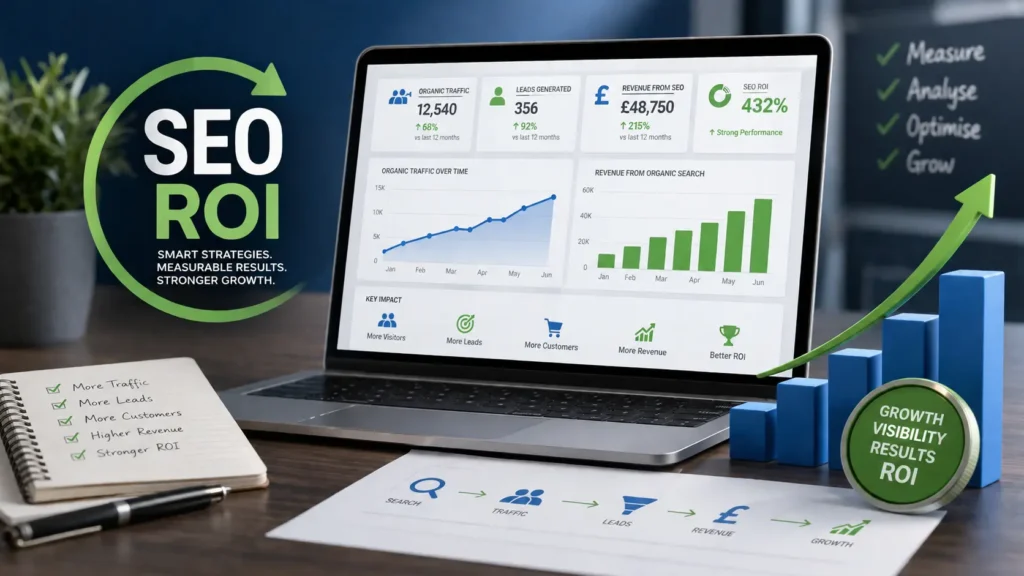
Investing in Search Engine Optimisation (SEO) is one of the smartest ways to build a long-term online presence. Unlike paid advertising, which only generates traffic while you’re spending money, SEO can continue to attract visitors, leads, and customers long after the initial work has been completed.
However, one question often arises for business owners and marketing managers:
“How can I tell if my SEO investment is delivering real business value?”
The answer lies in measuring your Return on Investment (ROI). Understanding SEO ROI allows you to evaluate whether your optimisation efforts are generating enough revenue to justify the costs. More importantly, it helps you identify which strategies are contributing to growth and which areas need improvement.
This guide explains how SEO ROI works, why it’s important, the metrics you should monitor, and practical ways to calculate the success of your SEO campaigns.
Understanding SEO ROI
SEO ROI is a performance metric that compares the financial return generated through organic search with the amount spent on SEO activities.
In simple terms, it answers the question:
“How much profit does my business make from every pound invested in SEO?”
The calculation is straightforward:
SEO ROI = ((Revenue Generated from SEO – SEO Costs) ÷ SEO Costs) × 100
For example:
- Monthly SEO expenditure: £1,500
- Revenue generated from organic traffic: £7,500
Calculation:
((£7,500 – £1,500) ÷ £1,500) × 100 = 400% ROI
This means your SEO campaign returned £4 in profit for every £1 invested.
Why Measuring SEO ROI Is Essential
Many businesses celebrate improvements in keyword rankings or website traffic, but these figures don’t always reflect commercial success.
Measuring ROI provides a much clearer picture by helping you:
- Evaluate whether your SEO campaign is profitable
- Allocate marketing budgets more effectively
- Discover which keywords generate the highest value
- Measure the quality of incoming leads
- Improve future SEO strategies using real data
- Compare SEO performance with other marketing channels
- Make informed business decisions based on measurable outcomes
Tracking ROI shifts the focus from vanity metrics to meaningful business growth.
Key Metrics That Influence SEO ROI
No single metric tells the complete story. Instead, several performance indicators should be analysed together.
Organic Website Traffic
An increase in organic visitors is usually one of the earliest signs that an SEO campaign is gaining momentum.
Monitor factors such as:
- Monthly organic sessions
- Traffic growth over time
- New versus returning users
- Best-performing landing pages
- Visitor locations
Google Analytics and Google Search Console are excellent tools for monitoring these trends.
Keyword Performance
Improved keyword visibility generally leads to greater search exposure and more opportunities for clicks.
Track the performance of:
- Primary commercial keywords
- Local search terms
- Long-tail phrases
- High-intent search queries
- Competitor rankings
Rather than aiming to rank for every keyword, focus on those most likely to generate enquiries and sales.
Organic Click-Through Rate (CTR)
Click-through rate measures how often people click on your website after seeing it in search results.
Formula:
CTR = (Clicks ÷ Impressions) × 100
Improving page titles and meta descriptions can often increase traffic without requiring higher search rankings.
Lead Generation
Traffic is only valuable if it results in potential customers.
Measure the number of enquiries received through:
- Contact forms
- Telephone calls
- Live chat enquiries
- Quote requests
- Appointment bookings
- Email enquiries
A successful SEO strategy should consistently increase the volume of qualified leads.
Conversion Rate
Your conversion rate indicates how effectively organic visitors become customers.
Formula:
Conversion Rate = (Conversions ÷ Organic Visitors) × 100
For example:
- Organic visitors: 2,000
- Completed enquiries or sales: 80
Conversion Rate = 4%
Driving traffic is only part of the process. Converting those visitors into paying customers is equally important.
Revenue Attributed to Organic Search
Ultimately, revenue is the strongest indicator of SEO success.
Track:
- Sales generated from organic traffic
- Revenue by landing page
- Revenue from individual keywords
- Revenue by service or product category
E-commerce businesses can usually monitor this directly through analytics platforms, while service-based companies often benefit from CRM integrations that connect enquiries to completed sales.
Customer Acquisition Cost (CAC)
Customer Acquisition Cost measures how much you spend to gain each new customer through SEO.
Formula:
SEO Investment ÷ Number of New Customers
Reducing your acquisition cost while maintaining lead quality improves overall profitability.
Customer Lifetime Value (CLV)
Many companies underestimate SEO because they only calculate the value of a customer’s initial purchase.
For example, a customer who first spends £500 may later:
- Purchase additional services
- Renew contracts
- Refer new customers
- Continue buying for several years
When long-term customer value is included, the return generated by SEO often becomes significantly higher.
Useful Tools for Tracking SEO ROI
Accurate reporting depends on using reliable analytics and SEO tools.
Google Analytics 4
GA4 helps businesses monitor:
- Organic traffic
- User behaviour
- Conversion events
- Revenue attribution
- Engagement metrics
Google Search Console
Search Console provides valuable search performance insights, including:
- Search impressions
- Clicks
- Average keyword positions
- Indexing status
- Top-performing pages
Customer Relationship Management (CRM) Systems
Platforms such as HubSpot, Salesforce, and Zoho CRM allow businesses to trace enquiries from their original organic search visit through to completed sales, making ROI calculations much more accurate.
Professional SEO Platforms
Popular SEO software includes:
- Ahrefs
- SEMrush
- Moz
- Screaming Frog
- BrightLocal
These platforms assist with keyword tracking, backlink analysis, technical audits, and competitor research.
Common Errors When Evaluating SEO ROI
Businesses often misjudge SEO performance because they rely on incomplete data.
Focusing Solely on Rankings
High rankings don’t always translate into increased revenue.
Instead, prioritise metrics such as:
- Qualified traffic
- Lead generation
- Sales
- Revenue growth
Expecting Immediate Results
SEO requires patience.
Typical timelines include:
- 3–6 months for noticeable improvements
- 6–12 months for stronger organic growth
- Ongoing optimisation for long-term success
Assessing ROI too early may produce misleading conclusions.
Ignoring Assisted Conversions
Customers rarely convert during their first website visit.
Their journey may involve:
- Discovering your business through Google
- Reading educational content
- Returning through social media or direct visits
- Making contact days or weeks later
SEO often plays a crucial role throughout this buying journey, even if it isn’t the final interaction before conversion.
Overlooking Phone Enquiries
Many local businesses receive a large proportion of enquiries via telephone rather than online forms.
Using call-tracking software enables you to attribute these enquiries to organic search traffic more accurately.
Neglecting Local SEO Performance
For businesses targeting local customers, additional metrics should be monitored, including:
- Google Business Profile views
- Phone calls
- Direction requests
- Local keyword rankings
- Google Maps visibility
- Customer reviews
These indicators have a direct impact on local lead generation.
Strategies to Improve Your SEO ROI
If your campaign isn’t producing the desired return, consider refining your strategy using the following approaches.
Target Commercial Intent Keywords
Prioritise search terms used by people who are ready to purchase rather than those seeking general information.
Improve Website Performance
A faster, more user-friendly website contributes to:
- Better user experience
- Higher search rankings
- Improved conversion rates
Optimise for Conversions
Ensure your website encourages visitors to take action by including:
- Clear calls to action
- Customer testimonials
- Trust signals
- Simple enquiry forms
- Easy navigation
Publish Helpful, Authoritative Content
Consistently producing informative and valuable content helps build trust with your audience while improving search visibility. Well-written articles also attract backlinks and encourage visitors to return to your website.
Build High-Quality Backlinks
Strong backlinks from reputable websites remain one of the most influential ranking factors.
Effective link-building methods include:
- Digital PR campaigns
- Guest blogging
- Industry collaborations
- Local business citations
- Shareable content resources
Review and Refine Your Strategy Regularly
SEO is an ongoing process rather than a one-time project.
Review campaign performance regularly and adjust your strategy based on:
- Ranking changes
- Competitor activity
- Search engine algorithm updates
- User behaviour
- Conversion performance
It’s also important to identify potential issues before they affect your campaign’s performance. Following best practices and understanding how to avoid common SEO mistakes can help businesses maintain a more effective SEO strategy and protect their long-term return on investment.
Continuous improvement leads to stronger long-term returns.
Conclusion
SEO delivers lasting value when its success is measured using meaningful business metrics rather than rankings alone. By monitoring organic traffic, lead generation, conversions, revenue, customer acquisition costs, and lifetime customer value, businesses can accurately assess the effectiveness of their SEO investment.
A data-driven approach not only demonstrates the true return on your SEO spend but also highlights opportunities to improve future performance. When tracked consistently, SEO becomes one of the most reliable and cost-effective channels for generating sustainable business growth.
Grow Your Business with Horizon Services
If you’re searching for an experienced digital marketing partner that focuses on measurable results rather than empty promises, Horizon Services can help. Before making your decision, it’s worth reviewing the questions to ask before opting SEO firm so you can choose an agency that aligns with your business goals and delivers transparent, measurable results. Based in Watford, UK, our full-service digital agency develops tailored SEO strategies designed to improve search visibility, attract qualified customers, and increase long-term revenue.
From technical SEO and content marketing to local optimisation and ongoing performance reporting, our team delivers strategies built around your business goals.
Discover how our expert team can help your business achieve better rankings and stronger returns by visiting our SEO company in Watford page today.


