
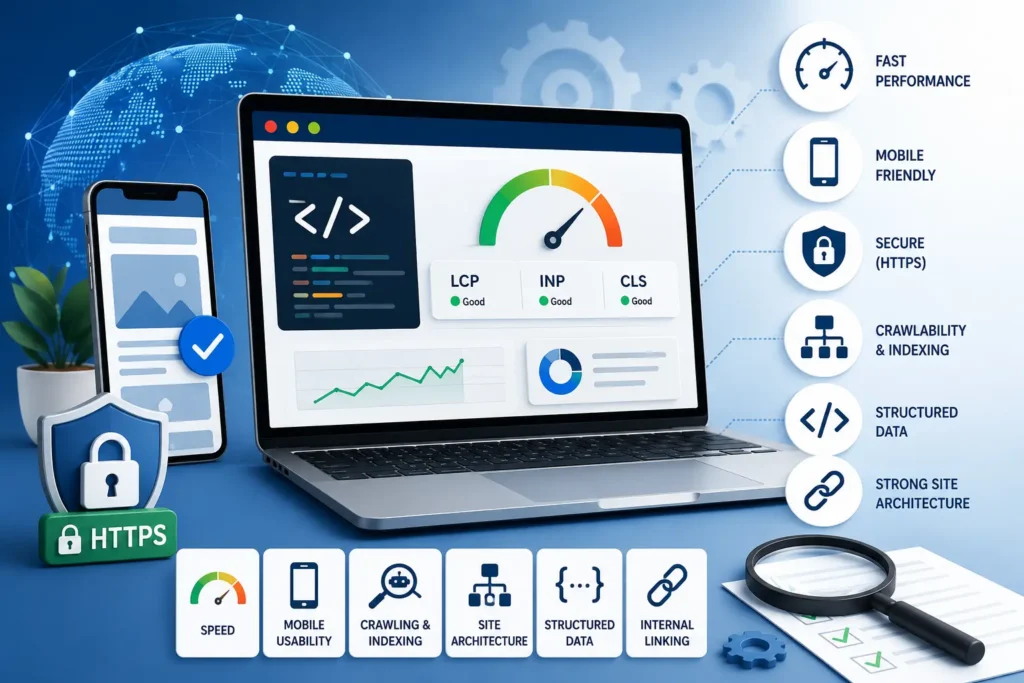
Achieving strong search engine rankings requires much more than publishing quality content and targeting relevant keywords. Search engines increasingly prioritize websites that deliver excellent user experiences, load efficiently, and are easy for crawlers to access and understand. This is why technical SEO has become a fundamental aspect of any successful digital marketing strategy.
Technical SEO focuses on optimizing the behind-the-scenes components of a website to ensure it performs effectively for both users and search engines. From improving loading speeds and mobile usability to strengthening security and streamlining indexing processes, technical SEO creates the foundation for sustainable online growth.
This guide explores the most impactful technical SEO factors that can improve website performance and contribute to higher visibility in search engine results.
Understanding Technical SEO
Technical SEO involves enhancing the technical framework of a website to help search engines crawl, interpret, and index content more efficiently. While content optimization targets relevance and user intent, technical SEO ensures that your website is structured in a way that supports those efforts.
Implementing a strong technical SEO strategy can lead to:
- Better search engine rankings
- Improved website speed
- Enhanced user experience
- Increased organic traffic
- Higher conversion potential
- Lower bounce rates
Below are the key technical SEO components every website owner should prioritize.
Improving Website Speed and Core Web Vitals
Website loading speed significantly influences both user satisfaction and search engine performance. Visitors expect fast experiences, and even small delays can result in users leaving your site before engaging with your content.
Google evaluates website performance through Core Web Vitals, which focus on real-world user experience metrics.
Largest Contentful Paint (LCP)
LCP measures how quickly the primary content on a page becomes visible to users. Ideally, this should happen within 2.5 seconds.
Interaction to Next Paint (INP)
INP assesses how responsive a website is when users interact with buttons, forms, or navigation elements.
Cumulative Layout Shift (CLS)
CLS evaluates visual stability by measuring unexpected layout changes during page loading.
Strategies to Enhance Website Speed
- Optimize and compress image files.
- Use modern image formats such as WebP.
- Minify CSS, JavaScript, and HTML resources.
- Implement browser caching.
- Utilize a Content Delivery Network (CDN).
- Enable lazy loading for multimedia content.
- Reduce unnecessary third-party scripts.
- Invest in reliable and high-performance hosting.
A faster website not only improves rankings but also creates a more enjoyable experience for visitors.
Prioritizing Mobile-Friendly Experiences
With Google’s adoption of mobile-first indexing, the mobile version of your website now serves as the primary basis for ranking evaluations.
A well-optimized mobile website should offer:
- Responsive layouts that adapt to all screen sizes
- Easy-to-read typography
- Simple and intuitive navigation
- Touch-friendly interactive elements
- Consistent content across mobile and desktop versions
Mobile Optimization Best Practices
- Test website functionality across various devices.
- Ensure mobile pages load efficiently.
- Maintain the same structured data on all versions of the site.
- Avoid intrusive pop-ups that disrupt user experience.
- Optimize visual elements specifically for mobile users.
Businesses that focus on mobile usability often see stronger engagement and improved search performance.
Securing Your Website with HTTPS
Website security has become an essential ranking consideration. HTTPS encrypts data exchanged between users and your server, protecting sensitive information from unauthorized access.
Benefits of HTTPS
- Builds trust among website visitors
- Enhances online credibility
- Supports stronger search engine rankings
- Safeguards user data during interactions
Steps to Implement HTTPS
- Install a valid SSL certificate.
- Redirect HTTP pages to their HTTPS equivalents.
- Update internal links and canonical references.
- Resolve any mixed-content warnings.
Security contributes significantly to both SEO success and customer confidence.
Ensuring Effective Crawling and Indexing
Search engines depend on bots to discover and index website content. Technical obstacles can prevent important pages from appearing in search results.
Optimizing Robots.txt Files
The robots.txt file guides search engine crawlers regarding which sections of your website they should or should not access.
Recommended practices include:
- Restricting access to duplicate or low-value pages
- Allowing crawlers to access critical resources
- Reviewing directives regularly to avoid accidental blocking
Utilizing XML Sitemaps
XML sitemaps provide search engines with a structured overview of your website’s important pages.
Effective sitemaps should:
- Include only valuable, indexable URLs
- Exclude redirects and error pages
- Update automatically when content changes
- Be submitted through Google Search Console
Managing Indexation Correctly
Use meta robots directives strategically:
- Index, Follow for pages intended to rank
- Noindex for pages that offer little SEO value
Proper index management helps search engines focus on your most important content.
Identifying and Resolving Crawl Errors
Technical issues such as broken links and server errors can negatively impact both user experience and search engine efficiency.
Common problems include:
- 404 error pages
- Broken internal links
- Redirect chains and loops
- Server-related issues (5xx errors)
Ways to Address Technical Errors
- Perform routine technical SEO audits.
- Replace or update broken links.
- Implement 301 redirects where necessary.
- Monitor Google Search Console for crawl issues.
Maintaining a technically sound website improves both accessibility and performance.
Leveraging Structured Data Markup
Structured data provides additional context about your content, enabling search engines to understand it more accurately.
Schema markup can be applied to:
- Frequently Asked Questions
- Product pages
- Service offerings
- Customer reviews
- Local business information
- Blog articles
- Breadcrumb navigation
Advantages of Structured Data
- Improved visibility within search results
- Enhanced eligibility for rich snippets
- Potential increases in click-through rates
- Better communication of content relevance
Schema implementation helps search engines present your content more effectively to users.
Building an Effective Website Architecture
Website architecture influences how easily users and search engines navigate your content.
An optimized structure should feature:
- Clear navigation menus
- Logical content organization
- Categories and subcategories arranged intuitively
- Important pages accessible within a few clicks
Benefits of Strong Site Architecture
- Improved user journeys
- Enhanced crawl efficiency
- Better distribution of page authority
- Increased discoverability of important content
Well-structured websites support both usability and SEO performance.
Developing a Strategic Internal Linking System
Internal links connect different pages throughout your website, helping both users and search engines understand content relationships.
An effective internal linking approach can:
- Guide visitors toward relevant resources
- Strengthen authority distribution across pages
- Improve crawl efficiency
- Increase engagement metrics
Internal Linking Recommendations
- Use descriptive anchor text naturally.
- Link strategically to important pages.
- Update links when new content is published.
- Avoid excessive linking that may dilute value.
A thoughtful internal linking strategy reinforces your overall SEO efforts.
Preventing Duplicate Content Issues with Canonical Tags
Duplicate content can create confusion for search engines and weaken ranking signals.
Canonical tags indicate which version of a page should be considered the preferred URL.
Common Uses for Canonical Tags
- Product pages with filtering options
- Multiple URLs displaying identical content
- URLs generated through tracking parameters
Proper canonicalization helps consolidate authority and prevents indexing complications.
Creating SEO-Friendly URL Structures
URLs contribute to both user experience and search engine understanding.
Characteristics of Optimized URLs
- Concise and descriptive wording
- Relevant keyword inclusion where appropriate
- Use of hyphens to separate words
- Minimal reliance on unnecessary parameters
- Consistent formatting throughout the website
Clean URLs make it easier for users and search engines to interpret page content.
Optimizing Images for Performance and Accessibility
Visual elements enhance engagement but can slow down websites if not managed effectively.
Image Optimization Techniques
- Compress files before uploading.
- Use modern formats such as WebP.
- Add descriptive alt attributes.
- Implement lazy loading functionality.
- Specify image dimensions to reduce layout shifts.
Proper image optimization supports faster loading times, accessibility standards, and improved SEO outcomes.
Managing Redirects Efficiently
Redirects play an important role when content moves or URLs change.
Common Redirect Types
- 301 Redirects: Permanent redirects that transfer SEO value.
- 302 Redirects: Temporary redirects intended for short-term use.
Redirect Best Practices
- Eliminate redirect chains whenever possible.
- Avoid redirect loops that prevent page access.
- Use redirects strategically to preserve user experience.
Effective redirect management helps retain ranking equity while maintaining seamless navigation.
Conducting Ongoing Technical SEO Audits
Technical SEO requires continuous attention rather than a one-time implementation. Websites evolve regularly, making ongoing monitoring essential.
Routine audits can uncover issues such as:
- Broken links
- Indexation problems
- Core Web Vitals deficiencies
- Structured data errors
- Security vulnerabilities
- Mobile usability concerns
Useful Technical SEO Tools
- Google Search Console
- Google PageSpeed Insights
- Google Analytics
- Screaming Frog SEO Spider
- Google Lighthouse
Regular evaluations enable businesses to identify and address technical issues before they affect performance.
The Importance of Technical SEO for Long-Term Growth
Technical SEO forms the backbone of a successful online presence. Even the most informative content may struggle to perform if the website itself suffers from speed issues, poor mobile experiences, or crawlability problems.
A strong technical SEO strategy can help organizations:
- Increase organic search visibility
- Improve user satisfaction
- Generate more qualified traffic
- Enhance conversion opportunities
- Strengthen brand credibility
- Stay competitive within their industry
As search engines continue to emphasize user experience, technical excellence remains a vital component of digital success.
Conclusion
Technical SEO plays a critical role in maximizing website performance and search visibility. By focusing on elements such as website speed, mobile optimization, security, structured data, crawlability, and ongoing maintenance, businesses can establish a solid foundation for sustainable growth.
Websites that consistently prioritize technical improvements are better positioned to achieve stronger rankings, attract more organic visitors, and deliver exceptional user experiences.
If you’re looking to improve your website’s performance through expert technical SEO strategies, partnering with experienced professionals can make a significant difference. Horizon Services provides comprehensive SEO services, web development, and digital marketing strategies designed to help businesses achieve measurable online growth.
Ready to strengthen your website’s technical foundation and improve your search visibility? Partner with the top SEO agency in Watford, UK and discover how strategic technical SEO can support long-term business success.


