
A website is more than just an online brochure—it serves as the digital face of your company. Whether you run a startup, a growing small business, or an established organization, your website plays a crucial role in attracting visitors, generating leads, and building trust with potential customers.
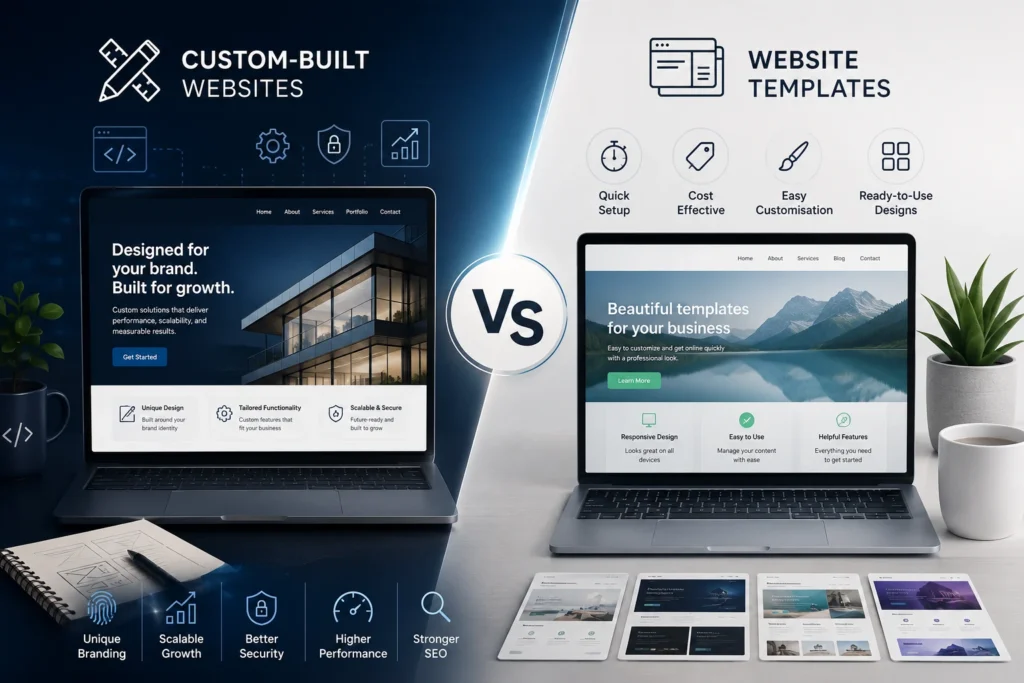
When planning a new website, one of the most significant decisions you’ll face is whether to invest in a custom-built website or use a pre-designed website template. Both options can help establish your online presence, but they differ greatly in terms of flexibility, cost, functionality, and long-term value.
This article explores the key differences between custom website design and template-based websites, helping you determine which approach aligns best with your business objectives.
What Is a Custom Website?
A custom website is designed and developed specifically for your business. Instead of relying on a pre-made structure, every component—from the visual design to the functionality—is created to meet your unique requirements.
Custom websites are built around your brand identity, target audience, and business goals, resulting in a highly personalized online experience.
Common Features of Custom Websites
- Bespoke design tailored to your brand
- Personalized user experience
- Advanced functionality and integrations
- Flexible architecture for future growth
- Improved performance optimization
- Enhanced security controls
- Complete ownership over design elements
Companies that prioritize differentiation and long-term scalability often choose custom website development as a strategic investment.
What Is a Template Website?
A template website is created using a pre-designed framework that can be customized with your branding, content, and images. Many website platforms provide a wide range of ready-made templates suitable for different industries and business types.
These websites offer a faster and more affordable route to launching an online presence.
Typical Features of Template Websites
- Ready-to-use layouts
- Quick deployment
- Lower development costs
- Basic customization options
- Standard website functionality
- Easy content management
- Minimal technical requirements
Template websites are commonly used by businesses that need a professional website without extensive customization.
Benefits of Choosing a Custom Website
Stronger Brand Differentiation
In competitive markets, standing out is essential. A custom website allows you to create a completely unique visual identity that reflects your brand’s values, personality, and goals.
Rather than looking similar to competitors using the same template, your business gains a distinct online presence that helps leave a lasting impression on visitors.
Tailored User Experience
Every business serves a different audience. Custom websites are designed with your specific users in mind, enabling developers to create intuitive navigation paths and conversion-focused experiences.
This often leads to:
- Increased engagement
- Better user satisfaction
- Higher conversion rates
- Reduced bounce rates
By focusing on how visitors interact with your website, a custom solution can contribute significantly to business growth.
Easier Expansion as Your Business Grows
Business needs rarely stay the same. As your company expands, you may require additional features, integrations, or functionality.
Custom-built websites are designed with growth in mind and can be adapted to support:
- Online stores
- Booking and appointment systems
- Customer dashboards
- Membership portals
- CRM and third-party integrations
This flexibility makes them a valuable long-term investment.
Greater SEO Opportunities
Search engine visibility is critical for attracting qualified traffic.
Custom websites provide greater control over technical SEO elements, including:
- Website structure
- Page speed optimization
- Mobile responsiveness
- Schema implementation
- Clean code architecture
- URL optimization
These factors can contribute to improved rankings and better search performance over time.
Improved Security Measures
Cybersecurity concerns continue to increase across industries.
Custom websites often include security features specifically designed for your business requirements, reducing reliance on generic third-party solutions.
Benefits may include:
- Secure coding practices
- Custom authentication methods
- Advanced protection measures
- Reduced exposure to common vulnerabilities
For businesses handling sensitive customer information, enhanced security can be a significant advantage.
Competitive Market Positioning
A professionally developed custom website can strengthen your credibility and help your business appear more trustworthy and established.
When potential customers compare multiple providers online, a distinctive and polished website often influences purchasing decisions.
Challenges of Custom Website Development
Larger Initial Investment
Creating a website from the ground up requires significant planning, design, development, and testing.
As a result, custom websites typically involve higher upfront costs compared to template-based alternatives.
Extended Development Process
Because every aspect is built specifically for your business, custom projects generally take longer to complete.
Depending on complexity, development timelines can range from several weeks to a few months.
Businesses requiring an immediate online presence may find this timeline less convenient.
Advantages of Website Templates
Budget-Friendly Option
One of the main reasons businesses choose templates is affordability.
Template websites provide a cost-effective solution for:
- Startups
- Freelancers
- Small businesses
- Local service providers
- New ventures
They allow organizations to launch professionally designed websites without a significant financial commitment.
Faster Website Launch
Template-based websites can often be deployed within a matter of days.
This speed is especially beneficial for businesses that need to establish an online presence quickly or launch a new product or service.
Easy Website Management
Many website builders are designed for users without technical expertise.
Business owners can often manage content updates independently, including:
- Editing pages
- Publishing blog posts
- Uploading images
- Updating contact information
This simplicity can reduce ongoing maintenance costs.
Wide Range of Design Choices
Modern website platforms offer thousands of templates tailored to different industries and business sectors.
Whether you operate in healthcare, retail, hospitality, education, or professional services, there are likely multiple template options available.
Built-In Functionality
Many templates come with useful features already integrated, such as:
- Contact forms
- Image galleries
- Blog functionality
- Social media integration
- Basic search engine optimization tools
These features can simplify the website creation process and reduce development requirements.
Limitations of Template Websites
Restricted Customization
Although templates allow some personalization, businesses may encounter limitations when attempting to create highly specific designs or features.
As customization needs become more advanced, these restrictions often become more noticeable.
Lack of Uniqueness
Popular templates are frequently used by numerous businesses across various industries.
As a result, your website may not effectively distinguish your brand from competitors.
Growth Limitations
As your company evolves, your website requirements may become more sophisticated.
Template websites can struggle to accommodate extensive functionality upgrades, potentially requiring a future redesign or migration.
Performance Concerns
Many templates include features and code that are not essential for every website.
This can result in:
- Slower loading times
- Reduced performance
- Potential SEO challenges
Website speed is increasingly important for both user experience and search engine rankings.
Reliance on External Developers
Template websites often depend on theme creators and plugin providers for ongoing support and updates.
If a template is discontinued or becomes incompatible with future software updates, maintenance can become more difficult.
Key Differences Between Custom Websites and Template Websites
Choosing between a custom-built website and a template-based solution requires a careful evaluation of several important factors. Understanding these differences can help you select the option that best aligns with your business objectives.
Budget Considerations
One of the most noticeable differences is the cost. Template websites are typically less expensive because they rely on pre-designed layouts and existing features. In contrast, custom websites require a higher investment since they are developed specifically for your brand, goals, and functional requirements.
Brand Uniqueness
A custom website is created exclusively for your business, allowing you to establish a distinctive online identity that reflects your brand’s personality and values. Template websites offer some level of customization, but their overall structure and design are often shared among many other businesses, making it harder to stand out.
Time to Launch
If speed is a priority, template websites have a clear advantage. Since the design framework is already built, they can be launched relatively quickly. Custom websites require a more extensive design and development process, which means longer project timelines but a more tailored end result.
Customization Capabilities
Custom websites provide complete creative and technical freedom. Businesses can incorporate specialized features, unique layouts, and custom integrations that support specific operational needs. Template websites, while flexible in some areas, often have limitations that can restrict advanced customization.
Ability to Grow with Your Business
As businesses expand, website requirements often become more complex. Custom websites are built with scalability in mind, making it easier to add new functionality and accommodate future growth. Template websites may meet current needs but can become restrictive as demands increase.
SEO Potential
Search engine performance is an essential factor for online success. Custom websites give developers greater control over technical SEO elements, including website structure, loading speed, and optimization strategies. Although many templates support SEO best practices, they may not offer the same level of flexibility and control.
Website Security
Custom-developed websites can include security measures designed specifically for your organization’s requirements. With template websites, security often depends on third-party themes, plugins, and regular updates, which can introduce additional maintenance responsibilities.
Long-Term Return on Investment
A custom website is often considered a long-term digital asset because it can evolve alongside your business and continue delivering value over time. Template websites provide a practical and affordable starting point, but growing businesses may eventually need to migrate to a more customized platform to support their evolving goals.
Making the Right Choice
The best solution ultimately depends on your business priorities, available budget, timeline, and future plans. Before making a final decision, it’s worth reviewing the top features to look for in website design and development services, along with the essential questions to ask before hiring a website design and development company. Doing so can help you evaluate potential agencies, understand their expertise, and ensure they can deliver a solution that aligns with your business goals. Organizations seeking a unique online presence, advanced functionality, and long-term scalability often benefit from a custom website. Meanwhile, businesses looking for a quicker and more budget-friendly way to establish an online presence may find a template website to be the right fit.
When a Custom Website Makes Sense
A custom solution may be the ideal choice if:
- Your brand requires a unique online identity.
- You need specialized functionality.
- Long-term growth is a priority.
- User experience plays a critical role in your business model.
- You require integration with internal systems or third-party tools.
- You view your website as a strategic business asset.
Businesses focused on expansion and market differentiation often gain the most value from custom development.
When a Template Website Is the Better Choice
A template website may be more suitable if:
- Budget constraints are a major factor.
- You need to launch quickly.
- Your website requirements are relatively straightforward.
- You are testing a new business idea.
- You plan to upgrade to a custom solution later.
For many startups and small businesses, templates provide an effective way to establish an initial online presence.
Thinking Beyond the Initial Cost
While template websites generally require a smaller upfront investment, it’s important to consider future requirements.
As businesses grow, they often need additional functionality, enhanced branding, and improved performance. In many cases, organizations eventually outgrow their templates and invest in a complete redesign.
A custom website may require a larger initial commitment, but it often delivers greater flexibility, scalability, and long-term value.
The best choice depends on your current needs, future goals, and the role your website plays in your overall business strategy.
Final Thoughts
Both custom websites and template-based solutions offer valuable benefits. Template websites are ideal for businesses seeking affordability, speed, and simplicity. On the other hand, custom websites provide greater flexibility, stronger branding opportunities, enhanced performance, and the ability to support long-term growth.
Before making your decision, carefully evaluate your business objectives, available budget, desired functionality, and future expansion plans. Selecting the right website solution today can have a significant impact on your business success tomorrow.
Elevate Your Online Presence with Horizon Services
Whether you’re looking to launch a brand-new website or upgrade your existing digital presence, partnering with experienced professionals can help you achieve better results. Horizon Services, a Watford-based full-service digital agency, delivers tailored web solutions designed to support business growth, improve user engagement, and maximize online visibility.
Discover website design and development services in Watford and learn how our team can create a website that not only looks impressive but also drives measurable business results.


