
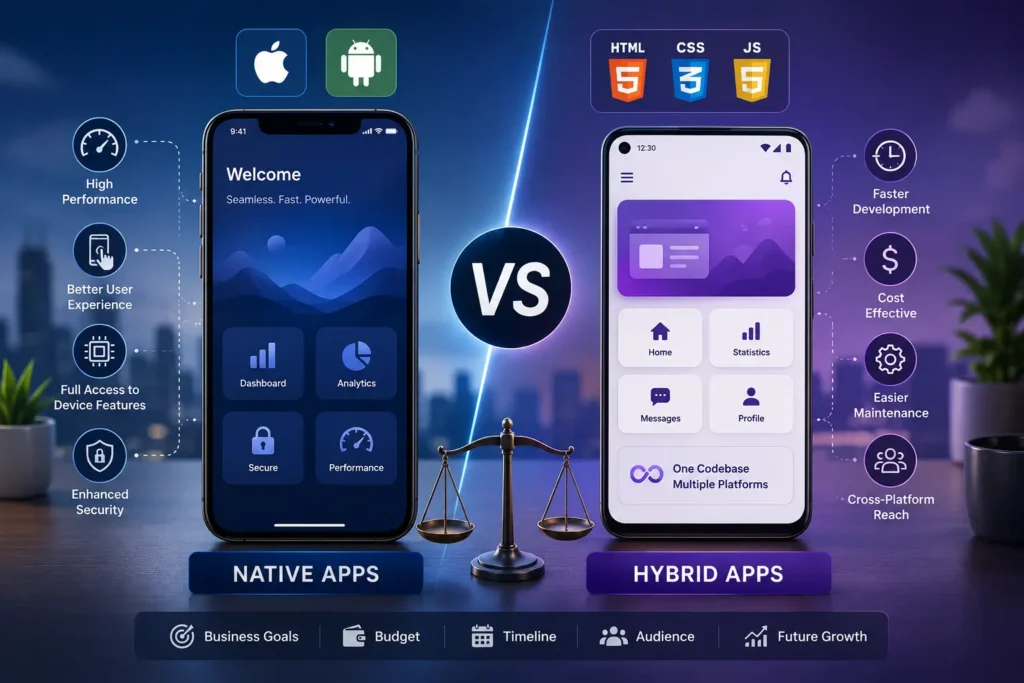
Mobile applications have become an essential part of modern business strategies. Whether you’re looking to improve customer engagement, offer digital services, increase sales, or streamline internal operations, investing in a mobile app can provide significant advantages. However, before development begins, businesses must answer an important question: Should you build a native app or a hybrid app?
Both approaches have distinct strengths and limitations. The ideal choice depends on your business objectives, budget, performance requirements, and future growth plans.
In this article, we’ll explore the key differences between native and hybrid applications, compare their benefits, and help you determine which option aligns best with your business needs.
What Are Native Mobile Apps?
Native apps are applications designed specifically for a single operating system. Developers create separate versions for iOS and Android using programming languages and tools recommended by each platform.
For instance:
- iOS applications are generally developed using Swift.
- Android applications are commonly built with Kotlin or Java.
Because native apps are tailored to a specific operating system, they can interact directly with the device’s software and hardware, delivering a highly optimized experience.
Benefits of Native App Development
Outstanding Speed and Efficiency
Native applications are built to work seamlessly with a device’s operating system. This allows them to perform tasks quickly, process data efficiently, and provide smooth interactions.
For businesses developing applications that require intensive processing, such as gaming platforms or financial services, native development is often the preferred option.
Improved User Experience
Users are familiar with the design patterns and navigation styles of their smartphones. Native apps follow platform-specific standards, making them easier and more intuitive to use.
This often results in:
- Better customer satisfaction
- Longer user sessions
- Higher retention rates
- Improved app ratings
Full Use of Device Capabilities
Native applications can easily integrate with various smartphone features, including:
- Camera functionality
- GPS and location services
- Fingerprint and facial recognition
- Bluetooth connectivity
- Push notifications
- Contact lists
- NFC technology
This flexibility enables developers to create feature-rich applications with advanced functionality.
Enhanced Security Standards
Native development allows businesses to leverage built-in security features provided by Android and iOS platforms. This can be particularly beneficial for industries handling confidential information, such as banking, healthcare, and e-commerce.
Challenges of Native Development
Greater Financial Investment
Building separate apps for multiple operating systems requires more development resources. Businesses often need dedicated teams for each platform, increasing overall project costs.
Longer Development Process
Since developers create individual applications for Android and iOS, the overall timeline tends to be longer compared to cross-platform alternatives.
Separate Maintenance Requirements
Every update, feature enhancement, and bug fix must be implemented independently across platforms, adding complexity to long-term maintenance.
What Are Hybrid Mobile Apps?
Hybrid apps combine web technologies with mobile application functionality. Instead of building separate apps for each platform, developers create a single codebase that works across both Android and iOS devices.
Hybrid applications are typically built using technologies such as:
- HTML
- CSS
- JavaScript
Popular frameworks used for hybrid app development include:
- Flutter
- React Native
- Ionic
- Apache Cordova
These frameworks allow developers to build applications once and deploy them on multiple platforms.
Benefits of Hybrid App Development
Faster Launch Times
Since developers work with a unified codebase, hybrid applications can be built and deployed more quickly than native apps.
This enables businesses to bring products to market faster and respond rapidly to customer demands.
Reduced Development Costs
One of the biggest advantages of hybrid development is cost efficiency. Maintaining a single codebase lowers development expenses and reduces the resources needed for future updates.
This makes hybrid apps particularly attractive for startups and growing businesses.
Simplified Maintenance
Managing one codebase instead of two means updates, improvements, and bug fixes can often be implemented simultaneously across all supported platforms.
Broader Platform Coverage
Hybrid development enables businesses to reach Android and iOS users without investing in separate development projects.
This helps maximize audience reach while minimizing development effort.
Limitations of Hybrid Apps
Potential Performance Constraints
While modern frameworks have significantly improved speed and responsiveness, hybrid apps may not always match the performance levels of fully native applications.
This is especially noticeable in graphics-heavy or resource-intensive applications.
Additional Configuration for Device Features
Accessing certain hardware functionalities may require plugins or additional integrations, which can increase development complexity.
Less Platform-Specific Customization
Although hybrid apps can deliver excellent user experiences, achieving the same level of platform-specific optimization as native applications can sometimes be challenging.
Dependence on Third-Party Frameworks
Hybrid apps rely on external frameworks that require ongoing updates and support. Businesses may occasionally face compatibility issues when frameworks evolve.
Native vs. Hybrid Apps: Side-by-Side Comparison
Performance
Native apps are specifically optimized for their operating systems and generally offer superior performance.
Hybrid apps perform exceptionally well for most business applications but may face limitations in highly demanding environments.
Advantage: Native Apps
Development Costs
Native development requires separate applications for each platform, resulting in higher costs.
Hybrid development uses a shared codebase, reducing expenses.
Advantage: Hybrid Apps
Time to Market
Developing two separate applications naturally takes longer than building one shared solution.
Hybrid apps allow businesses to launch more quickly.
Advantage: Hybrid Apps
User Experience
Native apps are designed around platform-specific guidelines, resulting in smoother and more familiar interactions.
Hybrid apps can provide excellent usability but may not fully replicate native behavior.
Advantage: Native Apps
Ongoing Maintenance
Maintaining multiple native codebases can increase workload and costs.
Hybrid apps simplify maintenance through centralized updates.
Advantage: Hybrid Apps
Long-Term Scalability
Native applications are often better suited for highly complex systems and advanced feature expansion.
Hybrid apps can scale effectively but may encounter limitations in extremely sophisticated projects.
Advantage: Native Apps
Situations Where Native Apps Make Sense
Native development is often the best choice when businesses require premium performance and advanced functionality.
Complex Mobile Experiences
Applications involving real-time processing, advanced graphics, or high-performance requirements typically benefit from native development.
Examples include:
- Mobile gaming applications
- Video editing tools
- Streaming platforms
- Financial trading systems
- Augmented reality experiences
Deep Hardware Integration
Businesses that rely heavily on device-specific capabilities can take full advantage of native development.
Premium Customer Experience
When user satisfaction is a top priority, native apps often provide the smoothest and most polished interactions.
Future Expansion Plans
Organizations expecting substantial growth and feature additions may find native architecture more suitable for long-term scalability.
Situations Where Hybrid Apps Are a Better Fit
Hybrid development offers numerous advantages for businesses focused on efficiency and affordability.
Startups and New Ventures
Businesses launching new products often need to validate ideas quickly while keeping costs under control.
Hybrid development provides an ideal balance between speed and functionality.
MVP Development
A Minimum Viable Product (MVP) helps businesses test market demand before making major investments.
Hybrid apps allow companies to gather user feedback and refine concepts without excessive spending.
Content-Focused Applications
Applications centered around content delivery often perform exceptionally well as hybrid solutions.
Examples include:
- Educational platforms
- News applications
- Corporate portals
- Community apps
- Customer service platforms
Multi-Platform Reach
Businesses aiming to target both Android and iOS audiences simultaneously can benefit from the efficiency of hybrid development.
How Modern Technologies Are Changing the Debate
The distinction between native and hybrid development has become less pronounced in recent years.
Frameworks such as Flutter and React Native have dramatically improved cross-platform performance, allowing businesses to create applications that closely resemble native experiences.
Many well-known companies successfully utilize cross-platform technologies because they offer:
- Faster development cycles
- Lower project costs
- Consistent branding
- Strong performance
- Easier maintenance
As development frameworks continue to evolve, hybrid solutions are becoming increasingly capable of supporting complex business applications.
Key Considerations Before Making a Decision
Define Your Business Objectives
Start by identifying what your application needs to achieve.
Ask questions such as:
- Will the app require advanced features?
- Is speed a critical factor?
- What user experience expectations exist?
Before moving forward with development, it’s also wise to prepare a list of questions to ask before hiring a mobile app development company. Understanding the mobile app development mistakes businesses should avoid can also help you make better decisions when evaluating potential partners, planning your project, and avoiding costly setbacks. Asking the right questions about technical expertise, development methodology, post-launch support, and previous project experience will help you choose a development partner that aligns with your business goals and ensures your app is built for long-term success.
Establish a Realistic Budget
Understanding your financial constraints can help determine whether native or hybrid development is the most practical choice.
Evaluate Your Timeline
If rapid deployment is important, hybrid development may provide a significant advantage.
Understand Your Audience
Customer expectations can influence the type of experience your app should deliver.
Consider Future Growth
Think beyond the initial launch and assess how your application may evolve over time.
Selecting the right architecture today can help avoid expensive redevelopment efforts in the future.
Final Thoughts
The choice between native and hybrid app development depends entirely on your business priorities.
Native apps excel in performance, security, customization, and user experience. Hybrid apps offer cost savings, faster development, and easier maintenance.
Rather than focusing on which option is universally better, businesses should evaluate which solution aligns most closely with their goals, budget, and long-term strategy.
By carefully assessing your requirements, you can make an informed decision that supports sustainable growth and delivers maximum value to your users.
Build the Right Mobile App with Expert Guidance
Whether your business requires a high-performance native application or a cost-effective hybrid solution, choosing the right development partner is crucial to success.
Horizon Services helps businesses transform ideas into innovative mobile experiences through strategic planning, intuitive design, robust development, and ongoing support. As a leading mobile app development agency in Watford, we create tailored mobile solutions that align with your business objectives and deliver measurable results. Partner with Horizon Services to develop a mobile app that enhances customer engagement, strengthens your brand, and drives long-term growth.


